
In an era where work is hybrid and classrooms are designed to engage increasingly attention-deficit generations, the phrase “wireless collaboration” is popping up across campuses, conference rooms, strategy decks. But what does it really mean?
Here’s what isn’t wireless collaboration. It’s definitely not untangling and passing around an HDMI cable. It’s not just about connecting devices to present content to in-room displays via Airplay or Miracast. And it’s not even screen sharing or screen mirroring in your meeting software.
Wireless collaboration takes content sharing a step further. It enables multiple users to display content within a space to compare their ideas simultaneously, fostering richer discussion. Instead of, “Can you please stop sharing?”, it’s, “Can you show us what you mean?”
Wireless collaboration is about transforming spaces into platforms for deeper understanding, richer engagement, and more equitable contribution. It’s about freeing ideas, (not just from wires), but from hierarchy, gatekeeping, and the friction that slows teams down.
Screen Mirroring, Screen Casting, and Screen Sharing: A Comprehensive Guide
From Screen Sharing to Shared Understanding
Think about the last time you “shared your screen.” If you’re like most people, it involved a single presenter, a static display, and maybe a few muted nods around the table or on the call. That’s screen sharing. And while useful, it’s often one-way and passive.
Now think about the most productive, thought-provoking meetings you’ve participated in. Better yet, think about the best conversations you’ve been a part of — business-related or otherwise. We’d venture to guess your best conversations happened in spaces that felt less formal — during coffee breaks in the kitchen, quick chats in between scheduled meetings, or even on walks through the park. Some place more . . . dynamic?
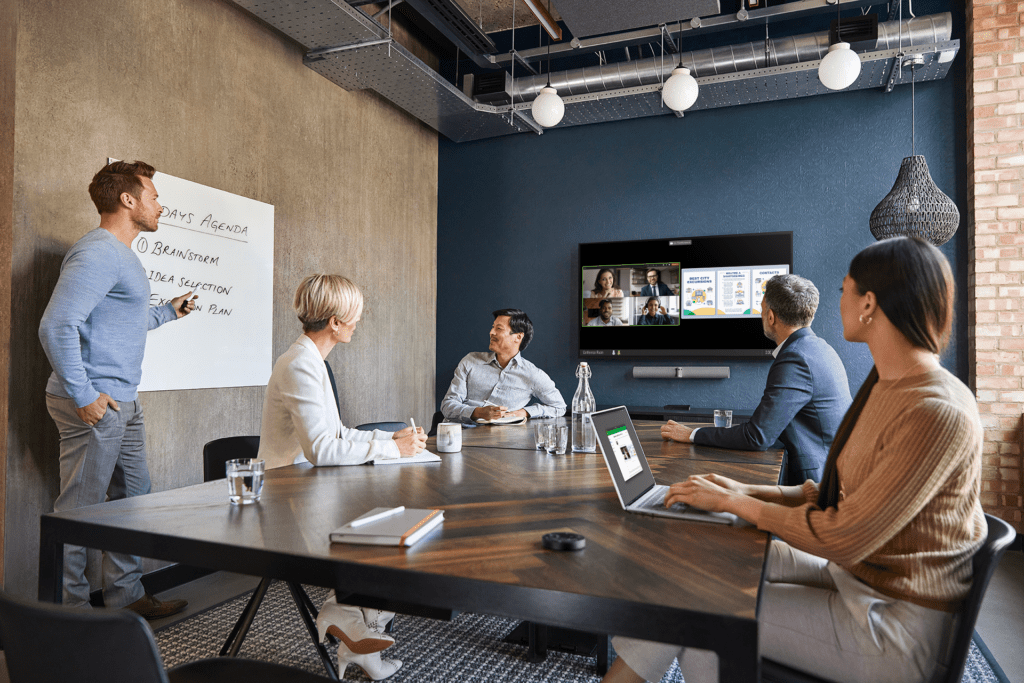
What if meeting spaces reflected environments with more spontaneity? Rooms where multiple participants, whether in person or remote, can share content at the same time. Where ideas are layered and compared in real time. Where a student in the back row, a quiet analyst, or a junior team member can contribute without fighting for the spotlight. Instead of forcing our communication styles to fit the mold of a rigid conferencing space, what if we built spaces that suit the way we naturally communicate and engage one another?
That’s wireless collaboration.
It turns every room into a stage for ideation, problem solving, and decision-making. It invites participation from all directions, not just from whoever has “the cable.” It allows people to connect. This means building on each other’s insights and challenging assumptions to move conversations forward faster.
The Wireless Advantage: Freedom and Fairness
So why is wireless so important to this evolution?
Wireless technology removes physical barriers. Presenters aren’t tethered to a podium or locked to the corner of the room. They can move, interact, teach, and engage with others naturally. Educators can walk among students. Executives can collaborate on the fly. Team leads can co-create instead of command. Wireless even eliminates one accessibility challenge, and not in a way that draws attention to someone needing special accommodation, but in a way that inherently allows all participants to connect without having to move to the front of the room.
Wireless enables democratization.
With traditional AV setups, there’s often a single connection point: one cable, one presenter. That model inherently favors hierarchy and limits interaction. Wireless collaboration opens the floor. Anyone can share. Multiple people can share. And they can do so from their own device (any device), in their own way, at the moment they have something valuable to contribute.
This matters deeply for inclusion. Not everyone feels comfortable jumping into a conversation. But being able to share a quick visual, a supporting doc, or a data point without asking for permission gives more people a say. That’s how teams unlock the full range of perspectives that drive better decisions.
But this doesn’t just mean a change in room design, it means a shift in how we conceptualize meetings. “Collaboration” implies ideation, problem solving, discourse, and bringing together unique perspectives to achieve an end goal. So, what if “meetings” looked different?
Collaboration As the Path Forward
There’s a common misconception that collaboration is indulgent, that it slows down productivity, and gets in the way of execution. Think: death by committee.
We disagree. Strongly.
When done right, collaboration is productivity. It streamlines decision-making. It avoids rework. It taps into collective intelligence instead of relying on top-down direction. And most importantly, it energizes how people show up to work.
True collaboration creates buy-in. It transforms meetings from “updates” into opportunities to solve real problems. And in today’s world where hybrid teams are the norm and burnout is high, that kind of engagement is essential.
In a joint study between Babson College and the Institute for Corporate Productivity (i4cp) evaluating over 1,100 companies, it was shown that companies with environments that fostered collaborative cultures were five times more likely to be high performing (2017). That’s not fluff. That’s ROI.
Building spaces that empower collaborative engagement creates a reason for your employees to actually want to come into work.
Instead of hybrid work that means sitting alone at your desk in office some days and sitting alone at your desk at home others, you can create work environments that add value to employees’ experiences.
Everyone wants to feel valued and respected. By designing around “wireless collaboration”, you’re building spaces and norms that honor your team’s autonomy and creativity.
A Better Way to Collaborate Without Compromise
At Mersive, we think wireless collaboration should be effortless, secure, and built for real people doing real work. That’s why we’ve redefined the experience with the Mersive Collaboration Suite, a software-driven platform that delivers multi-user sharing, intuitive control, and enterprise-grade security.
Unlike solutions that fragment your meeting room tech, Mersive offers flexibility and added value. You’re not stuck in one ecosystem. You’re not paying extra to bring your own device or leverage your own videoconferencing software. And you’re not sacrificing security just to move fast.
We believe you shouldn’t have to choose between openness and control or between ease of use and IT peace of mind. So we built a platform that gives you all of it from SOC 2 Type II attestation and HIPAA compliance, to seamless BYOD and BYOM integration, to facilitating both formal presentations and freeform brainstorming, while supporting a range of connection protocols (WebRTC, Airplay, Miracast, Google Cast, iOS and Android mobile) so that you and your users can quickly connect in the way that’s familiar to each of you.
Whether you’re a professor navigating diverse student needs, an AV manager wrangling complex deployments, or a small business IT leader making every dollar count, Mersive helps you create spaces that support the way people actually work.

The Future of Collaboration is Inclusive, Agile, and Human
We’ve entered a new chapter in how teams communicate. It’s no longer about who has the floor. It’s about how the room works and how it empowers voices, aligns minds, and accelerates outcomes.
Wireless collaboration isn’t just a tech trend. It’s a shift in mindset. A move from presentation to participation. From isolated workflows to collective breakthroughs.
And it’s just getting started.
Curious to see what wireless collaboration looks like in action?

How Wireless Collaboration Adoption Actually Happens, According to Mersive’s Director of Inside Sales

How Intuitive UX Design Makes Collaboration Software Work for Everyone
5 Reasons Hybrid Meetings Are Still Broken (and How to Fix Them)
What Is Screen Mirroring? A Complete Guide for Every Device.

Stop Losing Ideas in the Meeting Room: Why Collaborative Intelligence Is the Productivity Shift Your Team Needs