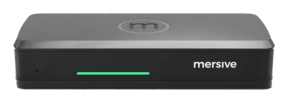
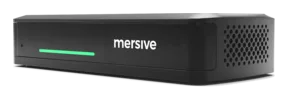
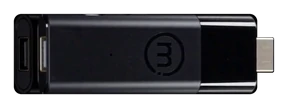
Screen sharing across guest Wi-Fi, VLANs, and segmented networks.
Subnets, VLANs, guest Wi-Fi, LTE, the building across town: one workspace, no VPN, no UC call, no cables. This is the capability that sets Polaris apart.
Every session here crosses a network
Guest on LTE in London shares to a Denver boardroom. Both ends dial out; media goes direct.
signaling — outbound TLS 443, both ends dial outmedia — direct between the two endpointsrelayed media — the fallback, one extra hopa NAT no direct path can cross
1. A guest on LTE tries to reach the display directly. No route exists, and none will be created.2. The share leaves their browser instead: outbound TLS signaling on TCP 443 to webrtc.mersive.com.3. The cloud introduces the two endpoints; they negotiate a direct, encrypted WebRTC connection. Nothing routes through Mersive; nothing bridges.4. Content flows device-to-display over that direct connection. Signaling is outbound-only on both sides: no inbound firewall rules.
thin dashes: signaling to the cloud, outbound TLSbold lines: media, direct between endpointsguest shares from the browser, no apphatched walls: routes that never exist; openings: negotiated flows only
The fallback, in full
When no direct path can be formed, the media takes one relayed hop.
The globe above ends one session in four this way. This is that hop, message by message — what the relay is asked for, what it is allowed to forward, and what it can see.
So the device stops trying to be reachable and asks a relay for an address of its own. The relay challenges it first: an allocation is authenticated, never anonymous.
A symmetric NAT gives every destination a different external port, so the address the display was handed is not the address packets would arrive from.
the device and its NATrelay control messages, then relayed mediaencryption the relay is outside ofhatched walls: the NAT and the firewall, neither of which is opened
Where this saves the day
Three rooms that break a LAN-local system.
The guest presenter
A board member walks in on LTE. No guest Wi-Fi sign-up, no VPN token, no dongle. They join the workspace from a browser and present in under a minute, with zero access to your network.
Corp, guest, AV, and OT networks that must never route to each other, by policy. Polaris keeps the isolation intact and still lands every source on the same display.
Polaris Cloud introduces the two ends of a share. It does not carry them.
When a source and a display sit on different networks, the signaling service at webrtc.mersive.com exchanges connection details between the sharing device and the display, and the two negotiate a direct, encrypted WebRTC connection between themselves. Your content travels from the device to the display. It does not pass through Mersive.
What reaches our cloud: session signaling, the connection details the two endpoints need to find each other. Not your screen.
What stays on your network: when a source and a display are already on the same network, the connection is negotiated with local addresses only and never leaves the LAN.
What never happens: no inbound firewall rules, no bridging of your networks. All cloud traffic is outbound TLS on TCP 443 from both sides. A guest device gets zero access to your network; the workspace is the only shared surface.
The short version
The combination of cross-network capability without a VPN, the workspace, and meeting parity with a composited workspace available in a web browser sets Polaris apart.
✓ No VPN✓ No UC call✓ No inbound holes✓ Guest gets zero network access✓ Every Polaris tier
Rogue signals are jamming the airspace above the room. You're the pod — clear the channel. Jammers rain static, splitters multiply, and every fourth wave the FIREWALL sweeps in. Downed signals drop powered displays: relay shield, dual beam, the piercing LANCE and the wide-angle SWEEP.
Shares keep coming. Compose the workspace — complete a row and it renders to the display. Hold a piece for later, trust the ghost, and slam it home when you're sure.
score: 0 · lines: 0 · level: 1 · best: 0
Mars · canyon relay
RELAY RUN
Aliens are looting Earth's audiovisual gear, and someone has to invoice them for it. You're the AV Integrator: fight through three decks of their freighter, shoot the capsules open, and take the equipment back — HDMI becomes a Blaster, a Display fans into Multicast, Coil fires Fiber, a Speaker is pure Subwoofer. Switches level your weapon, Surges take one hit for you. Snatchers steal; make them regret it. A boss holds every deck.
score: 0 · mission: 1/3 · best: 0
Pluto · deep-network maintenance
PACKET MUNCHER
Something is nesting in the farthest switch fabric. Run the corridors, eat every stray packet, and mind the four interference glyphs — each hunts its own way. Grab a powered display and, for a few seconds, the hunters become the hunted. Ten sectors between you and a clean network.
score: 0 · sector: 1/10 · lives: 3 · best: 0
Venus · broadcast campus
SIGNAL JUMPER
Ten displays across the broadcast campus went dark, and the interference is walking around like it owns the place. Run the loading dock, the cable trench, the rooftop, the mezzanine and the antenna tower, then push on through the uplink yard, the static fields, the rack canyon, the microwave bridge and master control — stomp the glyphs flat, bank the signal bits, bump the cache blocks, plant the midpoint flag, ride the ferries, and touch every display back to Polaris green. Game over offers a CONTINUE from the top of the level that beat you.
The campus's flagship display was stolen and walled up in a fortress beyond the north-east mesa. Cross a hundred screens of field, woods, river and dead server yard, crimper in hand — find the two small keys, mind the spikes, arrows and false floors, put five strikes into the CRT TYRANT's open screen, and raise the display where it belongs. Five hollow caves hide heart containers, and the RELAY TOWER on the south-west shore keeps the MERSIVE POLARIS — press X to grab what's in front of you, or to send the puck flying out and back.
The dongle users are pouring out of the rings in formation: HDMI drones, button wingmen, and the big conference pucks running the show. Hold the line in the Polaris fighter. They swoop in, regroup, breathe, and dive. Mind the boss pucks’ PAIRING BEAM — get caught and your fighter is theirs. Shoot that boss down mid-dive and your fighter comes home to fly beside you: DUAL FIRE. Every fourth wave is a demo stage — pure flying, pure bonus, PERFECT if you drop every last one.
score: 0 · wave: 1 · lives: 3 · best: 0
Mercury · the night side circuit
SOLAR CIRCUIT
A run cut across Mercury’s night side, Point A to Point B, against the clock. The sun never sets here and never rises either — it just sits on the horizon throwing its corona up the sky, and everything you can see is either lit by it or hiding from it. The route opens wide and fast, closes to a canyon barely three lanes across, climbs, and falls away again, four stages of it. Keep it on the basalt: the regolith either side will drag you down and take your speed with it. Stay clean and the craft keeps finding more — the longer you hold the line, the faster it will let you go, and the yellow pads are how you get there sooner.