A collaboration platform business case should compare more than hardware prices. A low-cost receiver can become expensive when guests cannot connect, rooms need several workarounds, support teams travel on site, updates are inconsistent, or a platform change forces replacement. A feature-rich system can also be poor value if the organization pays for capabilities people do not use.
The right model starts with the current room fleet, defines the outcomes the organization wants, calculates total cost of ownership over an agreed period, and tests how sensitive the result is to adoption, support, refresh, and risk assumptions.
- A business case compares the full cost, operational impact, risk and measurable outcomes of the current and proposed room models over time.
- TCO measures the investment; ROI evaluates whether verified benefits justify it.
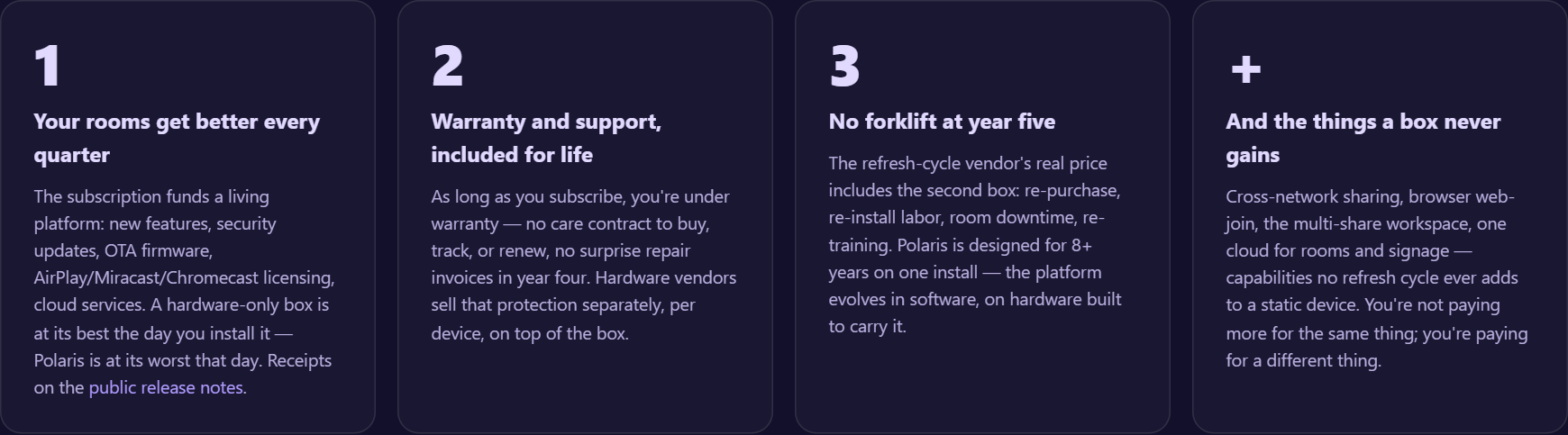
- A low-cost receiver becomes expensive when guests cannot connect, rooms need workarounds, support travels on site, or a platform change forces replacement.
- Meeting-room TCO has seven layers, from acquisition and implementation through recurring services, operations and meeting friction to lifecycle and risk.
- Publish the assumptions. A model whose inputs are hidden cannot be argued with, and will not survive finance review.
A collaboration platform business case compares the full cost, operational impact, risk, and measurable outcomes of the current and proposed room models over time. TCO measures the investment; ROI evaluates whether verified benefits justify it.
Start with the decision, not the product
Write the business question before building the spreadsheet. Examples include standardizing mixed rooms, improving guest collaboration, replacing aging hardware, supporting several meeting platforms, reducing on-site support, activating idle displays, or improving security governance.
Define the scope: rooms, locations, users, years, currencies, products, services, and business units. A pilot-room comparison and a global-fleet investment case should not use the same level of precision.
01Acquisition
Include endpoints, displays, cameras, microphones, speakers, controllers, transmitters, adapters, mounts, racks, cabling, network equipment, spares, taxes, shipping, and initial licenses. Separate reusable room assets from components that change with the collaboration platform.
02Design and implementation
Include site surveys, engineering, security review, network changes, installation, configuration, integration, testing, project management, training, documentation, travel, and change management. A replacement that fits existing infrastructure may reduce some costs, but validate the assumption by room type.
03Recurring services and licenses
Capture software subscriptions, cloud management, meeting-platform room licenses, support contracts, warranty extensions, monitoring, APIs, content services, identity, and third-party integrations. Model expected price changes separately from contractual commitments.
04Operations and support
Estimate administration, monitoring, updates, room checks, help-desk time, on-site dispatch, vendor escalation, inventory, content operations, and training. Use ticket and labor data where available. Do not convert every meeting inconvenience into a dollar without an agreed method.
05Failure and meeting friction
Measure start delays, failed sharing, guest problems, audio or video incidents, room abandonment, repeat meetings, and executive or customer impact. Separate observed incidents from assumptions and use a sensitivity range for the value of participant time.
06Lifecycle and change
Include software support periods, hardware refresh, compatibility changes, replacements, spares, secure disposal, platform migrations, construction, and the residual value of reusable assets. A room model that can evolve by software or modular components may have different lifecycle economics than an appliance tied to one service.
07Risk and governance
Consider security exceptions, unsupported devices, unpatched endpoints, personal accounts, unmanaged adapters, audit work, privacy incidents, vendor concentration, end-of-support exposure, and business continuity. Quantify only when the organization has an approved risk method; otherwise present the risk clearly alongside the financial model.
Benefits to measure
Two lifecycle cost bars compare a device-only purchase with a managed collaboration platform across hardware, operations, labor, and risk.
The proportions are conceptual, not a Mersive savings claim. Replace them with customer-approved assumptions in a published calculator.
- Acquisition
- Subscriptions and operations
- Deployment and support labor
- Refresh, downtime, and risk
- Faster meeting start. Possible measure: Median time to working audio, video, and content. Evidence source: Room telemetry, observation, user testing.
- Higher user success. Possible measure: First-attempt completion and guest-share success. Evidence source: Pilot tasks, support data, surveys.
- Lower support effort. Possible measure: Tickets, labor minutes, dispatches, spares, and escalations. Evidence source: Help desk, AV operations, vendor records.
- Fleet consistency. Possible measure: Rooms on standard, compliant configuration, and expired exceptions. Evidence source: CMDB, management platform, audits.
- Lifecycle flexibility. Possible measure: Assets retained during refresh or platform change. Evidence source: Architecture, procurement, asset inventory.
- Better collaboration. Possible measure: Task completion, participation, decision quality, or workflow-specific outcome. Evidence source: Controlled pilot, research, business-owner data.
The strongest benefits connect to an existing business measure. If the organization cannot observe the outcome, label it as a strategic hypothesis and design the pilot to test it.
A transparent TCO model
For each option, calculate the present or nominal cost over the agreed period using the organization's finance policy. At a minimum, show the following components separately:
- Initial hardware and installation
- Initial design, security, network, integration, and training
- Recurring licenses, cloud, support, and content services
- Annual administration, monitoring, help desk, and field support
- Expected replacement, spares, refresh, and disposal
- Migration or exit costs
- Approved risk allowances or qualitative risk assessment
- Measured benefits, timing, confidence, and responsible owner
Show base, conservative, and upside scenarios. Change one assumption at a time to identify what actually drives the result. A model that only works when every meeting saves an unverified number of minutes is not an investment case; it is a fragile story.
ROI, payback, and nonfinancial decisions
ROI is commonly calculated as net benefit divided by investment, but the organization should use its approved finance definition. Payback shows when cumulative verified benefits recover the investment. Net present value accounts for timing and discount rate. Some decisions, such as replacing unsupported endpoints or closing a material security gap, may be mandatory even when a conventional ROI is not the primary justification.
Present the financial result alongside adoption, risk, service quality, and strategic flexibility. A platform can have lower modeled cost and still fail if people do not use it or if it cannot support the required rooms.
How to build the business case
- Define the current state: Inventory rooms, components, licenses, support, incidents, refresh dates, user journeys, and known risks.
- Define the target outcomes: Choose measurable operational, experience, security, lifecycle, and business results.
- Create comparable options: Include the current model, minimum viable improvement, proposed platform, and any credible alternative.
- Build the TCO: Use the same period, room scope, labor rates, refresh policy, and cost categories for each option.
- Run a pilot: Measure technical performance, user success, support effort, management, adoption, and exceptions in representative rooms.
- Update and govern: Replace assumptions with evidence, assign benefit owners, approve the financial method, and track results after deployment.
How to frame the Polaris business case
Mersive Polaris proposes a common platform across shared workspace, flexible participation, hybrid meeting models, idle-screen signage, and cloud management. The financial hypothesis is that one coherent layer can reduce unnecessary room variation and let organizations step up capability by room type without rebuilding the complete operating model.
That hypothesis must be tested. Compare Polaris with the actual current fleet: existing displays and AV, supported products, installation, network work, licenses, cloud services, support, warranty, updates, training, signage operations, refresh, and migration. Then measure user success, support, room consistency, lifecycle, and adoption. Use approved Mersive or customer evidence only.
What costs belong in collaboration platform TCO?
Include hardware, design, installation, network, security review, integration, licenses, cloud services, support, administration, training, meeting friction, spares, updates, refresh, disposal, migration, and approved risk costs over the same time period.
How do you calculate collaboration platform ROI?
Use the organization's approved finance method. Define the investment, measure attributable benefits, subtract ongoing costs, state the period, and disclose assumptions and confidence. Avoid generic productivity values that have not been validated internally.
What is the most important pilot metric?
There is no universal metric, but successful completion of the intended room journey is a strong starting point. Combine it with time to start, guest success, support effort, room availability, and workflow-specific business outcomes.
Should security and platform flexibility be monetized?
Only through an approved risk or financial method. Otherwise, present them as scored strategic and risk criteria alongside TCO and ROI rather than forcing uncertain values into the model.